

homeRNA
Remote transcriptomics made easy with
robust extreme-temperature shipping and
patient-centric blood collection
A convenient patient-centric kit
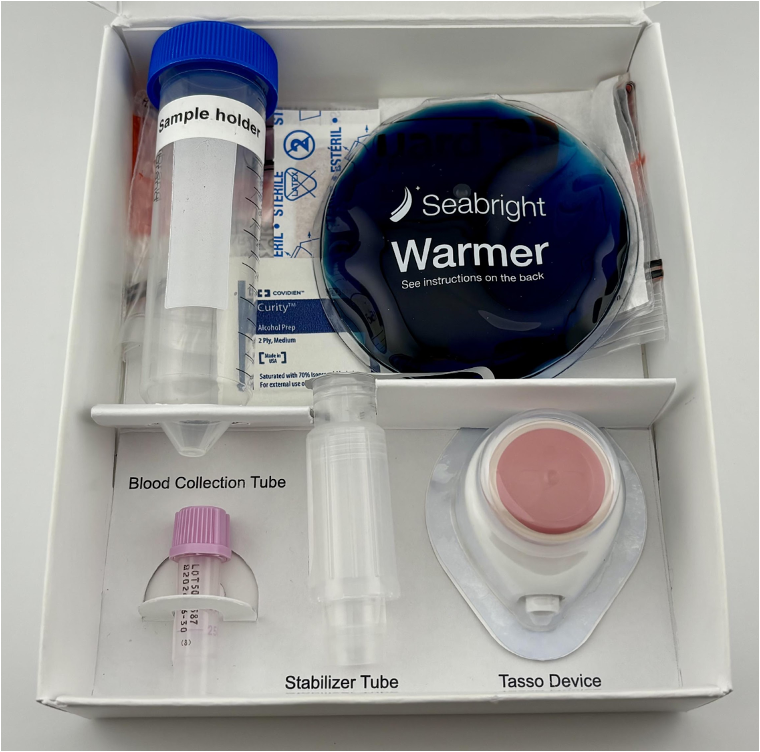
homeRNA is a kit for the self-collection and stabilization of whole blood in remote settings for use with whole blood RNA endpoints. homeRNA uses a virtually painless, patient-centric blood collection device, the Tasso+ or the Tasso Mini, that collects capillary blood from the upper arm into a collection tube. The tube then interfaces with a Seabright stabilizer tube that enables the mixing of a liquid stabilizer solution (RNAlater™) into the sample for stabilization across a range of temperatures and shipping times. homeRNA is a proven and highly published product, based on technology developed at the University of Washington.
More information on homeRNA can be found on our publications page and in the media (UW EDGE Center)
Simple patient workflow enabling at-home collection
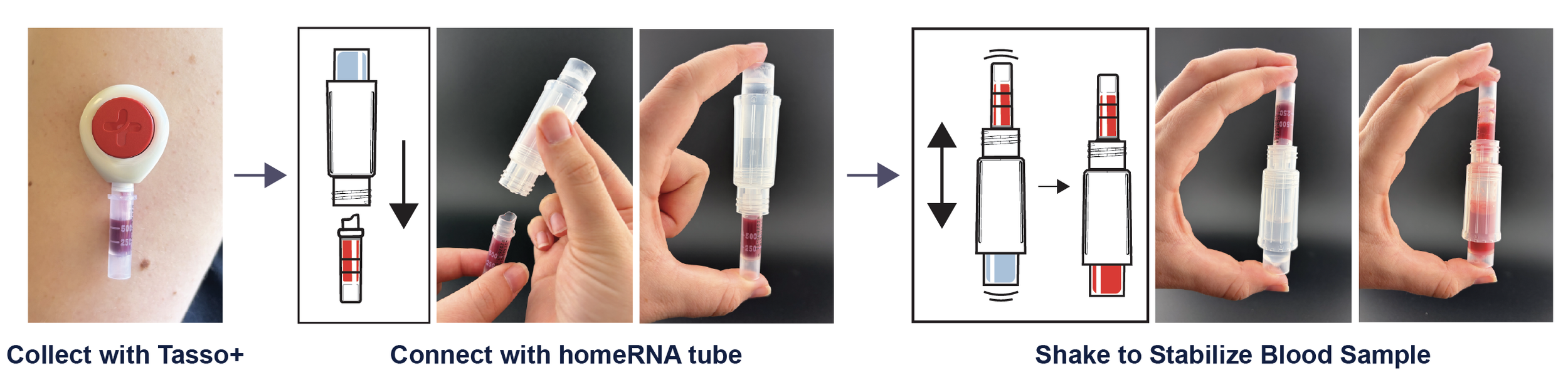
homeRNA is a demonstrated, simple, and robust method to collect a blood sample from home and mix in an RNA stabilization reagent to support shipping across a range of times and temperatures.
Proven simplicity and patient-preference
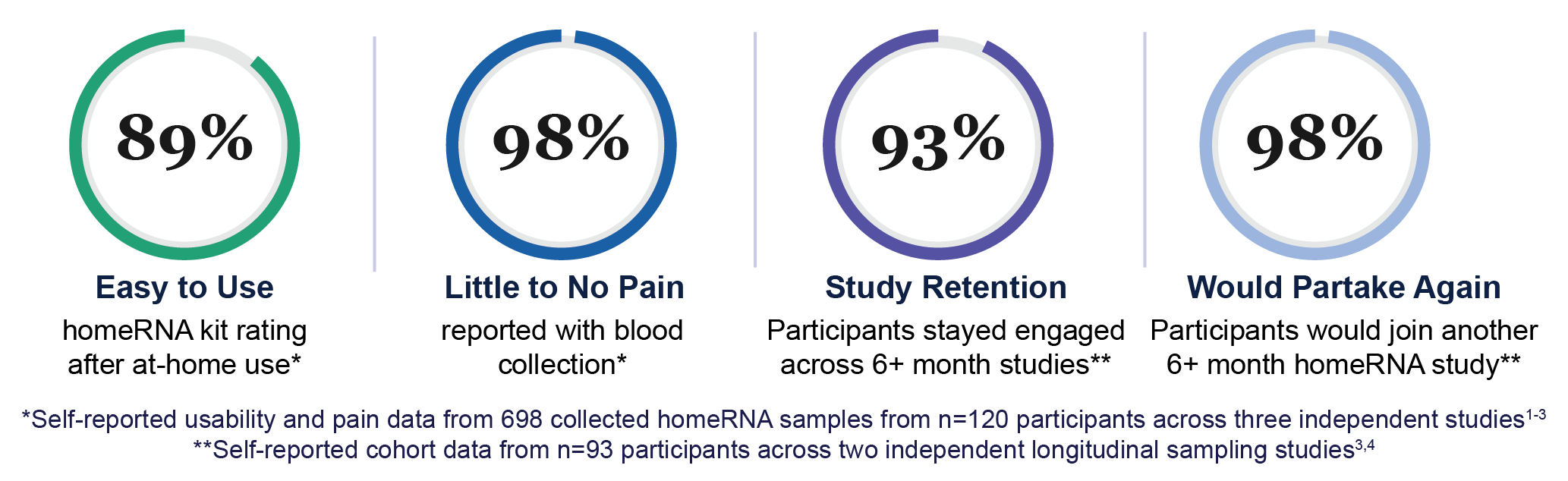
The homeRNA kit is a patient-centric and easy to use platform. Most participants reported that both the Tasso+ device and the stabilizer tube were “very easy” to use and the majority of participants report a painless experience with using the Tasso+ device. The study included men, women, and participants of all race/ethnicity categories defined by the NIH.
The homeRNA kit also focuses on user experience to drive participant retention and long-term recruitment. The majority of participants stay engaged across a 6+ month longitudinal remote sampling study and have reported that they would participate again in a similar longitudinal remote study design with homeRNA.
1. Haack*, Lim* et al. Analytical Chemistry, 2021. doi:10.1021/acs.analchem.1c02008 | 2. Eakman*, Stefanovic*, et al. bioRxiv, 2025. doi:10.1101/2025.11.24.690053
3. Haack*, Brown*, et al. medRxiv, 2025. doi:10.1101/2025.10.11.25337783 | 4. Stefanovic et al. medRxiv, 2026. doi:10.64898/2026.02.05.26345688
High-quality and high-yield supporting most RNA endpoints
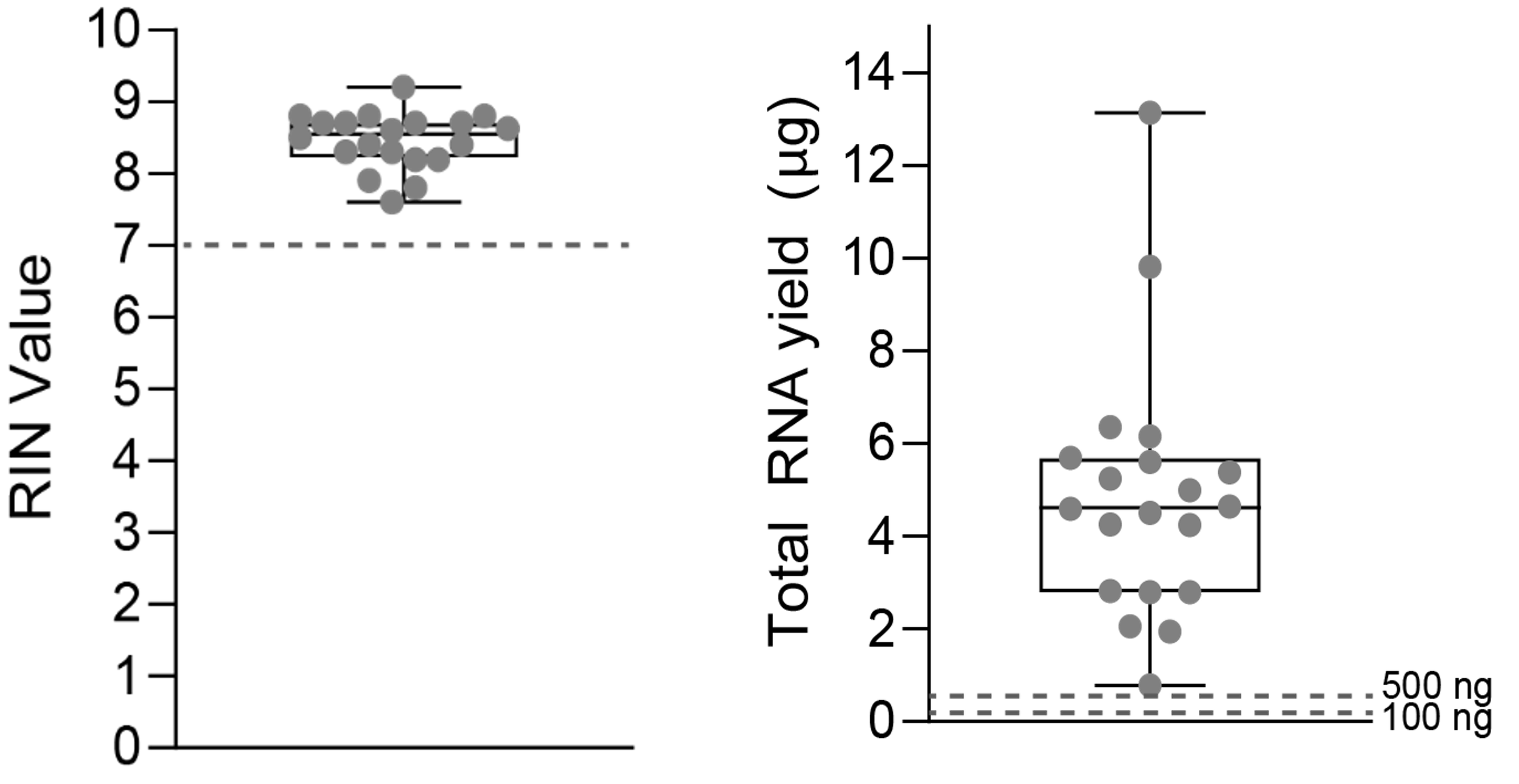
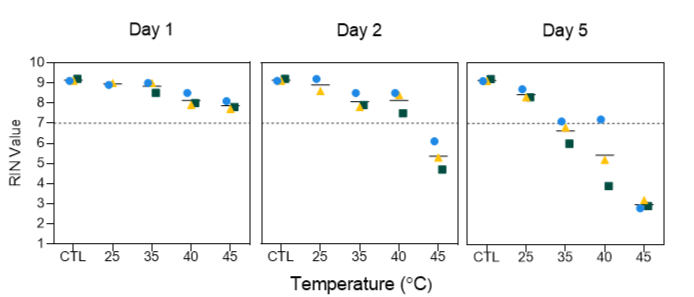
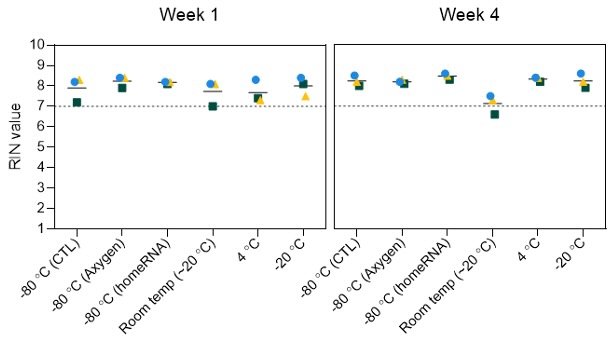
homeRNA stabilizes blood in liquid form, supporting high-volume capillary sampling solutions. Utilizing the Tasso+ or Tasso Mini system, typically 500 μL to 1 mL of whole blood can be collected. By keeping the sample in a liquid form, simply mixing it with an RNA stabilizing fluid, losses are minimized in downstream laboratory processing workflows. homeRNA yields high-quality RNA with RIN values of 7 to 9 after shipping and yields sufficient for downstream transcriptomics analysis.
RNA samples stabilized even at elevated temperatures
homeRNA preserves high-quality RNA suitable for transcriptomics analysis and other RNA endpoints across a range of times and temperatures. RNA integrity (RIN) is above 7 on Day 1, Day 2, and Day 5 for the samples incubated at 25 ºC, and the Day 1 and Day 2 for the samples incubated at 35 ºC and 40 ºC. The Day 5 incubation at 35 ºC is close to a RIN of 7 and could be used for most downstream transcriptomic analysis.
Simple long-term storage for batch processing and biobanking
homeRNA enables storage in a fridge or freezer upon reception for batching and biobanking. RNA integrity (RIN) is above 7 at week one and week four for the samples stored at 4 ºC, –20 ºC, and –80 ºC.
For space-constrained users, the blood collection tube can be simply detached yielding in a standard 5 mL tube that fits most deep freezer racks.
Contact us to order homeRNA
homeRNA is available today and powers applications worldwide today. Contact us for a quote or more information.
FAQs
-
-
-
This question comes up a lot. Studies performed by Tasso as well as independent publications have shown that upper-arm blood collection devices produce pain levels that are less than 1 on a scale of 0 to 10, with most users not feeling anything at all. A minority of users may feel a slight prick with a sensation that is typically far inferior to other blood collection methods (e.g. venous draws, finger lancets). The technology in the patient-centric sample collection space is improving rapidly too. For example, a few years ago, some of the previous versions of the Tasso blood collection devices had a higher percentage of users reporting some sensation of pain than the current Tasso devices used in the homeRNA and homeStable kits. Across the landscape of self-collection devices on the market, there are differences in pain sensation. Publications have ranked the Tasso device as the device with the least painful experience.
“I hope this becomes commonly used.”
Clinical study participant